









Just do it! Why new habits can be more powerful than therapy
Matthew Gobbett, Registered & Chartered Forensic Psychologist
Have you ever tried to make a behaviour change in your life? Maybe start a new diet? Or an exercise regime? It can be tough. A series of habits form our everyday lives. Most of these habits work for us, that's why we keep them. But sometimes things need to be changed. Making a lasting change to your routine is a challenge many of us take up, but often fail.
Cognitive Behavioural Therapy (CBT) has been a dominant form of therapy for 40 years, and its influence has impacted our understanding of behaviour change. The effect is seen not just within Psychology and therapy, but also popular knowledge about behaviour.
The relationship between thoughts, emotions and behaviour?
The premise of CBT is outlined in the figure below. It shows how our thinking, emotions and behaviour are closely intertwined, each influencing and impacting upon one another. So, applying the CBT model to someone who is trying out a new exercise regime, they may start out very motivated, but after a few weeks they may experience thoughts (cognitions) such as 'this is too hard', 'I can't keep this up,' and 'I just wasn't made to be fit'. These influence the person's emotions and they may feel 'dejected' or 'disappointed' in themselves. This, in turn, may influence their behaviour, and they may stay in the house, watch Netflix and eat snacks in a bid to feel better (we've all been there).
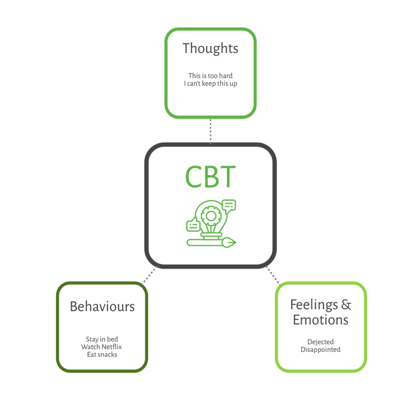
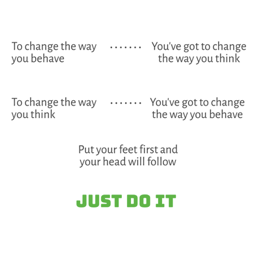
In my experience, CBT places emphasis on 'thinking' or the cognitions in this model, and sometimes the influence of emotions and behaviour is overlooked. It may be no coincidence that 'thinking' is at the pinnacle of the model above. It may also be no coincidence that the 'C' (cognitions) comes first in the name CBT. When I was training as a Psychologist and CBT was the dominant form of therapy. The popular maxim was 'you need to change the way you think to change the way you behave.'
While it is true that changing the way you think can impact on the way you feel and behave, have you ever tried to change the way you think? It's quite an undertaking, especially if your beliefs reflect long-standing views that you have formed about yourself and the world. Going back to the example above, if you are someone who struggled with sports and exercise in school, you may have formed an underlying belief that you were not biologically made to be fit and that exercise will never come easy. I have seen how CBT is a powerful way to change these beliefs, but it takes time and effort in therapy to do so.
The feel-good factor of habit
In recent years I have recognised how our emphasis on 'changing the way you think' has overlooked the power of emotions and behaviour in making important changes to our lives. Advances in neuropsychology have helped us understand how repeating a behaviour over time makes it easier to do. If the behaviour is positive and brings reward, you will feel good (emotion) about what you are doing. Under the right conditions that behaviour can become a habit; something your mind and body does with ease and almost expects to do. Over time this new habit can change the way you think about yourself, other people or the world. In this scenario, the behaviour is influencing the emotion and the thinking. So the maxim has flipped to 'change the way you behave, to change the way you think.'
Returning to our example of someone who has started a new exercise regime, but then feels like giving up, time could be spent in therapy challenging the belief 'I wasn't made to be fit' and constructing new positive beliefs. Alternatively, the person could be encouraged to develop a new positive behavioural habit that can be easily completed each day. For example, doing 10 minutes of yoga every morning. Once they start to complete and repeat this behaviour and (hopefully) feel good about it, their brain will make positive connections between the behaviour and the reward (feeling good). This behaviour is then more likely to become a habit. Over time the person may add additional exercises or complexities to their regime. The new habit will help in the way they feel and think about themselves, with time changing that old belief of 'I wasn't made to be fit.'
There are lots of good books out there describing the process of habit formation, my favourite being 'Tiny Habits' by B J Fogg.
Turn off Netflix and Just Do It.
While both the 'changing thoughts' and 'new habit' methods presented here can both lead to success. I have increasingly found that people respond better to the 'new habit' method. It is more practical, can be achieved with little or no input from a therapist, and elicits quick feedback and reward to the brain. Many of the people I work with find it more fulfilling than sitting in a therapy room and deconstructing thoughts.
I often encourage the people I work with to 'put your feet first and your head will follow.' Plan a new simple behaviour or habit and start doing it. If this is a success, the good feelings and positive thoughts will follow. To borrow Nike's famous slogan 'JUST DO IT.'
If you are interested in finding out more about developing habits and behaviour change, either for yourself or when helping people you work with, please contact us at the e-mail below.